
Welcome to the bayou, hunter. If you're new here, get ready. Hunt: Showdown drops you into a twisted, gothic vision of the 1890s Louisiana swamps—a place crawling with monstrous creatures where every other person you meet wants you dead. This isn't your typical shooter; it's a high-stakes blend of PvP and PvE that creates a kind of tension you won't find anywhere else.
So, What Is Hunt: Showdown?
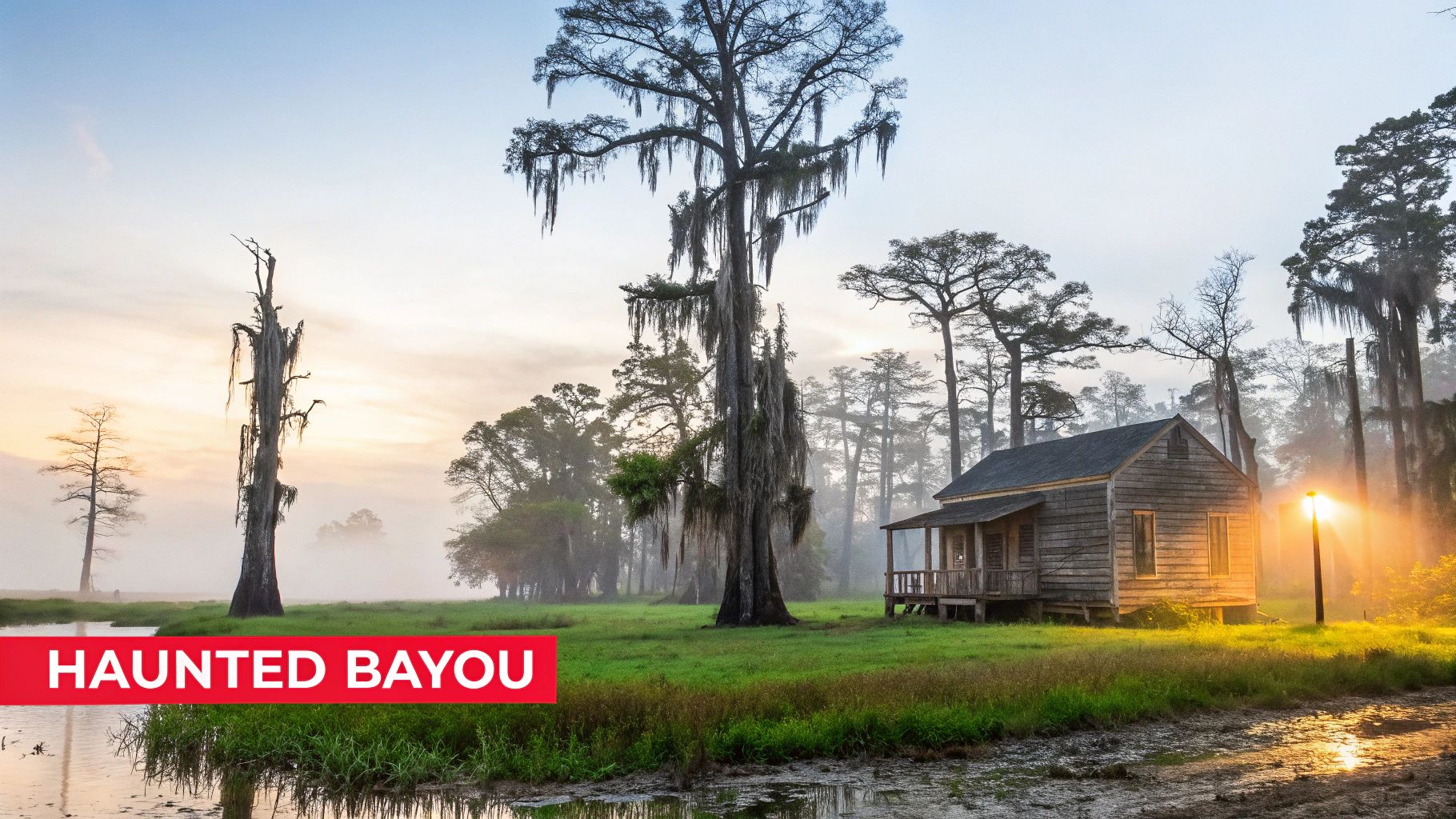
Picture a world where things that go bump in the night are very, very real. In Hunt: Showdown, you're a bounty hunter tasked with clearing these horrors out of the bayou. The catch? You're not the only one. Every match throws you in with other players all gunning for the same prize, which dials the paranoia up to eleven.
Every single sound matters. A snapped twig, a distant gunshot, the caw of a crow—it could be your doom, or it could be your next opportunity. It's this brutal, unforgiving world that has hooked a die-hard community. The game holds strong with around 28,341 daily active players on Steam alone, and with a recent monthly player gain of +9.34%, it's clear the bayou is only getting more crowded. If you're into numbers, you can find more detailed player statistics for Hunt: Showdown on tracker.gg.
The Core Gameplay Loop
Every match in Hunt follows a simple, brutal cycle of risk and reward. Getting this down is your first step to surviving, let alone thriving, out there.
- Gear Up: Before you head in, you’ll pick a hunter and kit them out with period-accurate weapons, tools, and consumables. Everything costs Hunt Dollars, so you’re constantly weighing the cost of your loadout against the risk of losing it all.
- Track the Target: Once you're on the map, your job is to find three clues that reveal the boss's lair. This part of the game is a slow, tense burn where you're constantly listening for the footsteps of other hunters.
- Fight the Beast: Found the lair? Now you have to kill a massive, grotesque monster, each with its own tricks and weaknesses. The fight is loud and messy, essentially ringing a dinner bell for every other team on the map.
- Get the Bounty and Get Out: After you kill the boss, you have to banish its soul and grab a bounty token. The moment you pick it up, your position is revealed to every hunter left alive. It all comes down to a mad dash to an extraction point to claim your prize.
This high-stakes loop—where one wrong move means losing your hunter and all their gear—is exactly what makes a successful extraction feel so incredible. Hunt rewards patience, smarts, and a healthy dose of courage.
Getting a Feel for the Hunt
If you want to survive in Hunt: Showdown, you'll need more than just a quick trigger finger. This game is all about mastering a deep, unforgiving set of rules that rewards patience and smarts over pure reflexes. It’s less of a run-and-gun shooter and more of a deadly puzzle, where everything from your weapon choice to the crunch of your boots can mean the difference between extracting with a bounty and a swift trip back to the main menu.
The combat itself feels raw and authentic. The weapons are all period-accurate, so forget about lightning-fast reloads and laser-like accuracy. You'll be wrestling with heavy recoil, slow-loading single-shot rifles, and bullets that actually have travel time. You have to lead your targets and account for bullet drop, which turns every shootout into a tense, calculated duel.
Your Ears Are Your Best Weapon
In the bayou, silence is golden—and incredibly rare. Nearly everything you do makes a sound that can give you away. Startle a flock of crows and they'll erupt into the sky, alerting everyone nearby. Get too close to a caged dog and it'll bark its head off. Even a single misplaced step on a branch can be heard from fifty meters away.
But here’s the thing: this works both ways. A clever hunter can turn the soundscape into a weapon. You can toss a decoy to fake footsteps and bait an enemy into the open, or you can deliberately trigger a sound trap on the other side of a compound to create the perfect diversion for an ambush. Seriously, learning to listen is just as crucial as learning to shoot.
The best hunters aren't just quiet; they're maestros of manipulation. They use the bayou's natural sounds against their opponents, turning someone else's situational awareness into a deadly trap.
The game's entire progression system is built around these high stakes. When you succeed, your hunters level up and unlock Traits—powerful passive perks that can do things like boost your stamina recovery or let you carry extra gear. But there’s a massive catch: permadeath. If your hunter dies, they're gone. Forever. Along with all their expensive gear and hard-earned experience.
Keeping Your Hunter Alive
That constant threat of loss makes every single decision feel incredibly important. You have to carefully manage your hunter’s health, which is broken up into bars that can be permanently burned away in a firefight, leaving you vulnerable for the rest of the match. On top of that, you need to know when and how to use all your gear.
Here's a quick look at what you’ll be juggling:
- Health: You use medkits to patch yourself up, but be warned—fire and certain explosives can destroy your health chunks for the rest of the match.
- Tools: This is your utility belt. Think traps, decoys, throwing knives, and other gadgets that give you a tactical edge.
- Consumables: These are your one-shot power plays, like fire bombs, dynamite sticks, and powerful syringes that grant temporary boosts.
This blend of deep mechanics and a rich, atmospheric world has made Hunt: Showdown a massive hit, pulling in an incredible $156.6 million in gross revenue. It’s a huge testament to the game's design and the dedication of its players. If you're curious, you can check out more stats on Hunt's impressive financial performance on Sensor Tower.
Naturally, such a passionate community is always looking for an edge. While most focus on strategy and skill, some players explore third-party tools. For anyone wondering about the official rules on that front, you can read our guide that digs into the question: are game cheats illegal? Knowing the rules of engagement—both in and out of the game—is all part of mastering the hunt.
Choosing Your Hunting Ground
Alright, so you’re ready to step into the bayou. Hunt: Showdown isn't a one-trick pony; it offers a couple of distinct ways to get your adrenaline fix. Figuring out which game mode clicks with you is the first step, whether you're a careful planner who thrives with a team or a lone wolf who loves a good old-fashioned brawl.
Each mode completely changes the feel of the match, from the pacing to the kinds of danger you'll run into. Let's dig into the two main ways you can hunt.
Bounty Hunt: The Signature Experience
This is it. This is Hunt: Showdown in its purest form. Bounty Hunt is the main event, the experience that defines the game. It’s all about tracking down monstrous bosses, banishing them back to hell, and then making a desperate run for an extraction point with a bounty token in your pocket—all while other hunters try to take you down and steal it for themselves.
You can go in alone, with a partner, or as a team of three. No matter how you squad up, the map will always have up to 12 players total, all with the same goal. It's a slow-burn thriller where a single gunshot can echo for what feels like miles, attracting every threat in the area. Nailing a successful extraction means you walk away with a fat stack of Hunt Dollars and precious experience for your hunter.
The real magic of Bounty Hunt is that you’re not just fighting the AI monsters. You’re playing a terrifying game of cat-and-mouse against other people who are just as smart, scared, and deadly as you are.
Soul Survivor: A Faster, Solo Fight
If Bounty Hunt is a tense, tactical marathon, think of Soul Survivor as an all-out sprint. This mode is for solo players only. You're dropped into the map with a randomly equipped, free hunter and have to immediately start scavenging for better weapons and gear.
Your first objective is to find and close Rifts to absorb their energy. Once you've collected enough, you become the Wellspring, and your location is instantly revealed to every other player on the map. From that point on, it’s a desperate fight for survival. To win, you simply have to be the last one breathing. The best part? If you win, you get to keep that hunter and all the cool gear you picked up, adding them to your permanent roster for free. It’s a fantastic way to warm up or build your hunter lineup without risking your hard-earned cash.
To make it even clearer, let's break down the core differences between the two modes.
Game Mode Comparison: Bounty Hunt vs. Soul Survivor
Here’s a quick look at how the two primary game modes stack up against each other, helping you decide where to spend your time.
| Feature | Bounty Hunt | Soul Survivor |
|---|---|---|
| Team Size | Solo, Duo, or Trio | Solo Only |
| Main Objective | Kill bosses, extract with bounty tokens | Be the last hunter alive |
| Match Pace | Slow, tactical, and strategic | Fast, aggressive, and chaotic |
| Rewards | Hunt Dollars, XP, kept hunter & gear | Winner keeps scavenged hunter & gear |
Ultimately, both modes offer a unique slice of the Hunt experience. Bounty Hunt is the deep, strategic heart of the game, while Soul Survivor provides quick, chaotic bursts of action. Jump into both and see which one gets your blood pumping
Your First Steps to Surviving the Bayou
Let's be honest, your first few hours in Hunt: Showdown are going to be brutal. You will die. You will lose your favorite hunter. You’ll likely stare at the "YOU ARE DEAD" screen and wonder what on earth you could have done differently. Don't sweat it. Every grizzled veteran of the bayou started out exactly where you are.
This isn't your typical shooter where a lightning-fast trigger finger wins the day. It's all about information and awareness. The single most important skill to pick up early is learning how to move like a ghost. Crouching is your best friend—it muffles your footsteps, letting you sneak around while you listen for the clumsy movements of others.
Mastering Your Senses and Surroundings
You have to start thinking of the map itself as one giant alarm system. A snapped twig, a flock of startled crows, a growling monster… every single sound tells a story about where players are and where they're headed. Learning to read these audio cues is what separates the hunter from the hunted. It’s how you set the ambush instead of walking right into one.
Here are a few core survival tips to drill into your head:
- Avoid Sound Traps: Give crows, caged dogs, and horses a very wide berth. Setting them off is the equivalent of firing a flare gun straight into the air. You’re just asking for trouble.
- Listen Before You Move: Pause before storming a new compound. Just stop for a second and listen. Is that the groan of a Grunt, or is it another hunter healing? That tiny bit of patience can save your life.
- Pick Your Battles: You don't have to fight everyone you see. If a team has better guns or a better position, there's zero shame in backing off and finding a new angle. It's always better to escape with your life than to die for nothing.
Building on a Budget
You're going to lose hunters and all their gear. It’s not an "if," it's a "when." To keep from going broke, you need to master the art of the budget loadout. It's all about finding cheap gear that can still get the job done.
The point of a budget run isn't just to save money; it's about cost-efficiency. You want gear that gives you the highest chance of bringing home more than you spent.
A fantastic starter combo is the Romero 77 shotgun and a basic Nagant M1895 pistol. The Romero gives you terrifying one-shot potential up close, and the Nagant is a reliable backup. Toss in a medkit and a weak vitality shot, and you've got a solid kit that won't bankrupt you if things go south.
This strategy keeps you in the game, allowing you to learn from every match without the stress of losing a fortune. Once you get a better feel for the flow of a match, you can start splashing out on the fancier toys.
Advanced Tactics to Dominate Your Matches
So, you’ve got the basics down. You’re not jumping at every crow caw anymore and you’re actually making it out alive with a bounty token now and then. Good. Now it’s time to level up from just surviving to truly dominating the bayou. This is where Hunt: Showdown shifts from a spooky shooter into a high-stakes game of chess.
It's all about changing your mindset. Instead of just reacting to what happens, you start making things happen. You’ll be pulling the strings, playing mind games, and mastering the brutal, beautiful dance of a Hunt firefight.
It all starts with controlling the map. You need to stop running from clue to clue and start thinking a few steps ahead. Where will other teams likely spawn? Based on the boss lair, which path will they take? Where are the best ambush spots along that route? By anticipating enemy movements, you get to pick the time and place for every fight, turning their hunt into your trap.
Setting the Perfect Trap
The most satisfying kills in Hunt are the ones where your opponent walks right into a trap they never saw coming. Making them feel like they have the upper hand is an art. You can do this by intentionally making a little noise—a single gunshot, a half-finished generator—to bait a team into your crosshairs.
Feeling bold? Start the boss fight, make a ton of noise, and then slip away into a well-covered position. Let every other team on the map converge on the lair, thinking you're vulnerable, only to find themselves tangled in a nest of your bear traps and concertina wire.
Sound is your best friend here. A perfectly thrown decoy or a blank fire can make enemies look the wrong way for just a few critical seconds. That's your window to flank, rotate to a better position, or just disappear into the shadows if things get too hot.
You’re not just a hunter; you’re a storyteller. Your goal is to create a false narrative that the enemy team believes. While they’re chasing the story you’ve fed them, you’re lining up the real final chapter.
Crafting a Deadly Loadout
Once you’re consistently earning Hunt Dollars, you can graduate from penny-pinching loadouts to more specialized, high-impact kits. This is where the real fun begins. You can start creating powerful synergies by combining specific weapons and custom ammo types that complement each other.
For example, try pairing a long-ammo rifle with a shotgun running flechette rounds. You can tag an enemy from a distance to make them bleed, forcing them to stop and bandage while you push in close to finish the job with the shotgun. It's a nasty one-two punch.
Think about the kind of playstyle you want to enforce:
- Pressure and Push: Load up with incendiary or poison ammo. A single hit can force an enemy to abandon their cover, flushing them right out into the open for an easy follow-up shot.
- Long-Range Lockdown: Slap a marksman or sniper scope on your rifle. You can completely control wide-open areas and shut down any team trying to rotate across your sightline.
- Close-Quarters Chaos: Nothing says "get out of my compound" like a pair of dual-wield pistols loaded with dumdum rounds. The sheer volume of fire and bleeding pressure can overwhelm anyone who dares to push you.
In the competitive world of Hunt: Showdown, players are always looking for ways to gain an edge. Some players explore third-party tools to improve their aim or gain better situational awareness. The upside many see is a potential boost in their performance, helping them land difficult shots or react faster. For players considering these options, it's a good idea to be aware of the game's terms of service and weigh the performance benefits against any associated considerations.
Getting Your PC Ready for the Bayou
In a game like Hunt: Showdown, a sudden frame drop isn't just annoying—it's a death sentence. To avoid getting gunned down because your PC decided to stutter, you need to make sure your rig is up to the task.
At the bare minimum, Crytek says you'll need an Intel i5-4590 CPU, a NVIDIA GeForce GTX 660 TI, and 8 GB of RAM. But let's be real, "minimum" just means the game will launch. It doesn't mean it'll be a smooth experience when bullets and dynamite start flying.
For a true competitive edge, you'll need to roll up your sleeves and dive into the settings. A few smart tweaks can give you a massive performance boost without turning the beautiful, murky bayou into a pixelated mess.
Fine-Tuning Your Graphics for Performance
The name of the game is finding that perfect balance between visual quality and buttery-smooth frames. Not all settings are created equal; some are serious resource hogs, while others barely make a difference. Knowing what to turn down is key.
Here are the big ones to focus on:
- Object Quality: Lowering this is a great way to gain FPS, especially when you're fighting in a cluttered compound. You'll barely notice the difference in a firefight, but your GPU will thank you.
- Shadows: This is the big one. Dropping shadows to low is probably the single best thing you can do for your framerate. As a bonus, it can actually make it a tiny bit easier to spot hunters hiding in dark corners.
- Anti-Aliasing: This setting smooths out jagged edges, but it comes at a steep performance cost. Turning it off or setting it to its lowest option will make your game feel much snappier and more responsive.
Finding your perfect settings is a bit of a personal journey. Start by dropping these three settings way down, then slowly crank them back up one by one until you land on a stable framerate you’re happy with. The goal is consistency.
A well-configured system is your best friend in the bayou. Some players take this even further with advanced hardware and software configurations. If you're curious about those deeper technical topics, our guide to HWID spoofing is a good place to start.
Got Questions About Hunt: Showdown? We've Got Answers.
Stepping into the bayou for the first time can feel overwhelming, and let's be honest, even veteran hunters have questions. It's a complex, punishing game, but that's what we love about it. We've pulled together some of the most common questions we see floating around the community to get you pointed in the right direction.
A big one that trips up new players is progression. Your Bloodline Rank is your main account level. As you rank it up, you'll unlock more weapons, tools, and all the fun gadgets you can bring into a match. Your individual hunters also level up, but that's temporary—when they die (and they will), that level resets, but all the XP they earned still goes toward your permanent Bloodline.
Can You Play Hunt: Showdown Solo?
You absolutely can. While Hunt is famous for its tense team-based gameplay, going in as a solo player is a whole different beast—and a totally valid way to play.
You can queue into a standard Bounty Hunt match alone against duos or trios for the ultimate high-risk, high-reward challenge. Or, you can jump into the Soul Survivor mode, which is a quick, free-for-all experience designed specifically for solo players.
How Do Players Get a Competitive Edge?
It's no secret that some players are always looking for an advantage in the bayou's deadly firefights. Beyond just pure skill, some in the community turn to third-party tools to help with things like aiming or spotting hidden enemies. The idea is to boost their in-game performance and give them more confidence when a gunfight kicks off.
For players curious about these kinds of tools, you can find more info about Hunt Showdown undetected cheats on dedicated community sites. It's a way for people to see what's out there and decide if the potential upside is worth it for them, while keeping the game's rules in mind.
No matter how you play, information is everything in Hunt. Knowing the map, learning to read sound cues, and predicting where other hunters will be is the most powerful weapon you can have.
Finally, everyone wants to know the best way to make money. Extracting with a bounty token is the most obvious and lucrative way to fill your bank, but don't ignore the little things! Keep an eye out for cash registers and small pouches of money hidden around the compounds. And always, always loot hunters you take down—you might just find a nice pile of cash on them.
At ABCheats, we build reliable tools to help you conquer the bayou. See what we have to offer at https://abcheats.com.