
Ever been locked out of a game and heard someone throw around the word "spoofer"? It sounds a bit techy, but the concept is actually pretty simple. Think of it as a digital disguise for your computer.
It's a software tool that temporarily masks your PC's unique hardware IDs, making it look like a brand-new machine to game servers and their anti-cheat systems. This is a game-changer for anyone trying to get a fresh start or get back in the action after a hardware ban.
So, What Exactly Is a Spoofer?
Let's break it down. Every single computer has a collection of unique digital fingerprints. These aren't just one thing; they're a mix of serial numbers from your motherboard, your hard drive, your network card—you name it. Game developers use these fingerprints, often bundled together as a Hardware ID (HWID), to identify your specific PC.
A spoofer cleverly steps in and swaps out these real fingerprints for fake ones. It's not a permanent change, just a temporary mask that helps the game see you as if you're on a completely different computer.
For a gamer hit with a hardware ban, this is a lifeline. Instead of having to buy all new parts, a spoofer gives you a clean slate, letting you create a new account and jump right back into your favorite games from your existing setup.
What’s the Main Goal?
The number one reason gamers use a spoofer is to get around a hardware ban. When a game's anti-cheat flags your system's components, it can blacklist your entire PC, making it difficult to play from any account on that machine. A spoofer is the most direct and effective way to address this problem.
Think of it like this: a hardware ban is a game changing the locks on your door. A spoofer is like a temporary master key that gets you back inside. It doesn’t permanently alter your hardware, it just gives you a different identity to get past the gatekeeper.
The Different Flavors of Spoofers
While the end goal is usually the same, spoofers can target different parts of your PC's identity. Knowing the types helps you understand how they work under the hood.
Here’s a quick rundown of the most common types of spoofers and what they do.
Quick Guide to Spoofer Types
| Spoofer Type | What It Changes | Primary Use Case |
|---|---|---|
| HWID Spoofer | Motherboard, CPU, and disk drive serial numbers. | The go-to for bypassing game-specific hardware bans. |
| MAC Spoofer | The unique address of your network card (MAC address). | Getting around network-level bans or restrictions. |
| IP Spoofer | Your public IP address (your PC's internet location). | Often used with a VPN to appear from a different location. |
| GPS Spoofer | Your device's physical location coordinates. | Common in mobile games like Pokémon GO. |
Each type serves a specific purpose, but for PC gamers dealing with tough anti-cheat systems in titles like Valorant or Call of Duty, the HWID spoofer is almost always what they're talking about.
How Spoofers Actually Work
To really get how a spoofer pulls off its magic, you first need to understand how anti-cheat systems operate. They don't just look at your account; they profile your entire PC. Every single component—your motherboard, your hard drive, your graphics card—has a unique serial number burned into it from the factory.
Anti-cheat software grabs all these numbers and smashes them together to create a one-of-a-kind digital signature for your machine. This is your Hardware ID (HWID).
Think of it like your computer's DNA. It's a unique profile that games use to identify your specific rig. When you get a hardware ban, they’re not just banning your username. They're blacklisting your PC's entire DNA profile, making it difficult to play from that machine, no matter what account you use.
This is where a spoofer comes in. It’s basically a digital disguise kit for your computer, letting you swap out that blacklisted HWID for a fresh, clean one.
The Art of the Mask
A spoofer doesn’t go in and permanently tattoo new serial numbers onto your hardware. That would be messy and irreversible. Instead, it works much more elegantly by intercepting the prying questions from the game's anti-cheat.
When the anti-cheat asks, "Hey, what are this PC's serial numbers?" the spoofer jumps in front and hands it a fake ID. It presents a completely different set of numbers, tricking the game into thinking you're on a brand-new computer that's never been seen before.
It’s like putting a temporary, but totally convincing, fake license plate on your car. The car itself hasn't changed, but to any cameras checking, it looks like a different vehicle. This is how you can hop back into your favorite game on a new account.
The best part? It’s not permanent. As soon as you turn the spoofer off or just restart your computer, your PC goes back to showing its real, original hardware IDs. No lasting changes, no permanent weirdness.
Digging Deep: How They Operate
Not all spoofers are created equal. Their effectiveness really depends on how deep they can get into your system's core operations. The more advanced the anti-cheat, the deeper the spoofer needs to go.
Here's a quick look at the different levels they work on:
-
Surface-Level Changes: The most basic spoofers just change the easy stuff, like your network card's MAC address. Some older anti-cheats might be bypassed by this, but most modern ones are more thorough.
-
Kernel-Level Control: The heavy hitters operate at the kernel or driver level of your operating system. This is deep-level access, allowing them to mask the really core identifiers that anti-cheats love to check, like your motherboard or disk drive serial numbers.
Working at the driver level is what separates the good spoofers from the great ones. It allows them to create a disguise that's not just a flimsy mask but a comprehensive new identity for your PC, which is crucial for bypassing today's super-invasive anti-cheat systems.
Understanding this technical side of things shows you just how sophisticated these tools can be. It’s this kind of know-how that allows providers like ABCheats to develop effective solutions that get players back in the game.
The Different Kinds of Spoofers Explained
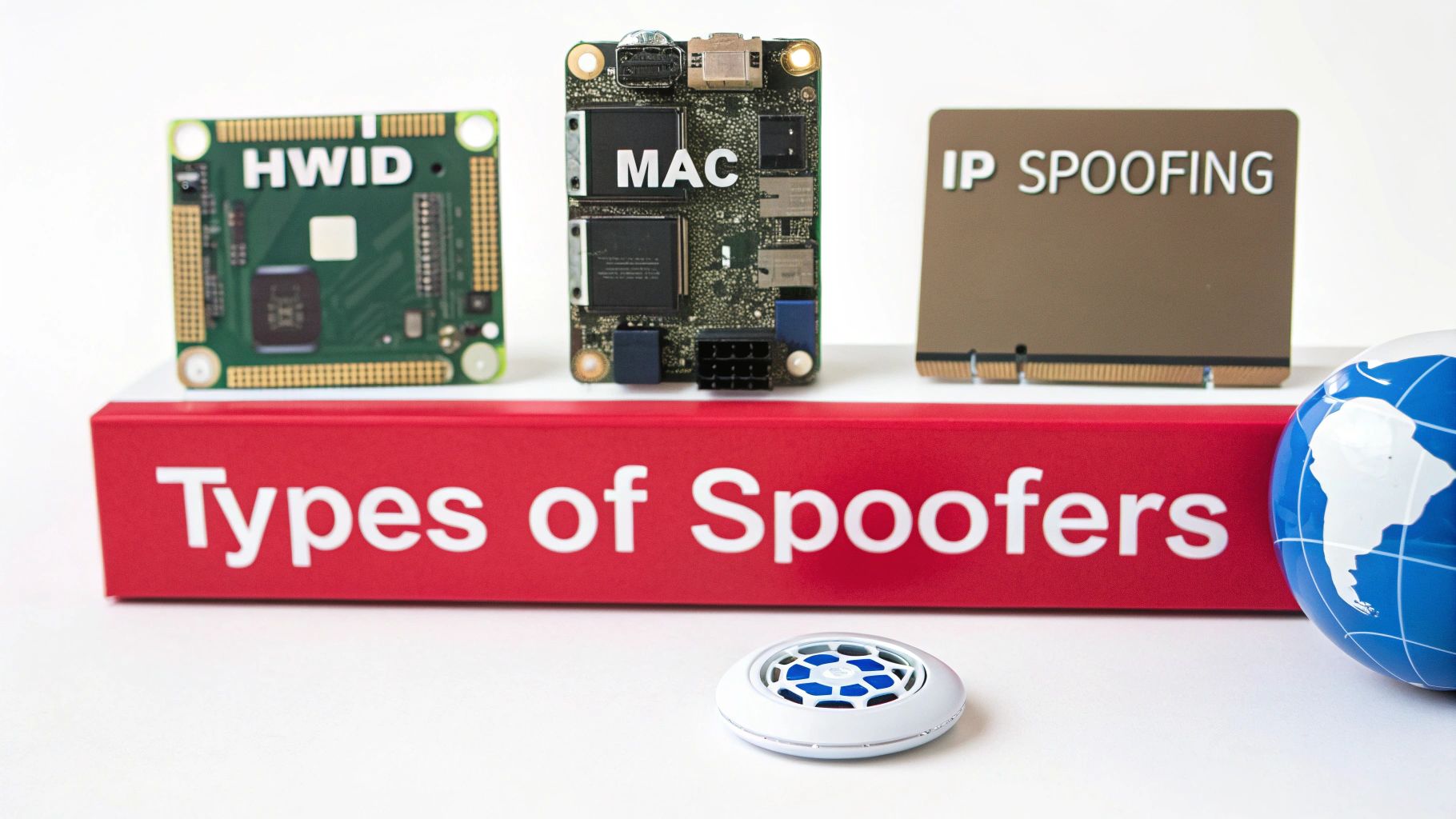
The word "spoofer" gets thrown around a lot, but it's not a one-size-fits-all term. Think of it as a broad category, like "tools." You wouldn't use a hammer to turn a screw, right? Same idea here. Different spoofers are designed to mask different parts of your digital footprint.
Knowing the difference is crucial, especially in the gaming world where anti-cheat systems are always getting smarter. Let's break down the main types you'll run into.
HWID Spoofers: The Go-To for Gamers
When you hear a gamer talking about a "spoofer," nine times out of ten, they mean a HWID spoofer. This is the big one, the tool designed to deal with the most frustrating problem a player can face: a hardware ban. Games like Valorant, Apex Legends, and Call of Duty don't just ban your account; their anti-cheat systems can blacklist your entire PC.
So, how does a HWID spoofer work? It digs deep into your system and changes the unique serial numbers of your core components—the motherboard, CPU, hard drives, you name it. It essentially gives your PC a brand-new identity, making it look like a completely different machine to the game's servers. This is why it's the most effective way to get back in the game after a hardware ban.
MAC Spoofers: A More Niche Tool
A MAC spoofer is much more specific. It only changes one thing: your MAC (Media Access Control) address. Every device that connects to a network, from your PC's ethernet port to its Wi-Fi card, has a unique MAC address that acts like a serial number for that specific piece of hardware.
It's a simpler tool for a simpler job. While a MAC spoofer alone might not be enough for the advanced anti-cheat systems in most major titles, it can be useful for dodging network-level restrictions or bans on specific game servers that still rely on MAC addresses for identification.
IP and GPS Spoofers: All About Location
Finally, we have spoofers that focus on faking your location.
- IP Spoofers: Your IP address is your computer's public address on the internet. Tools like VPNs are essentially IP spoofers, masking your real IP to make it look like you're browsing from somewhere else. This is great for accessing geo-locked game servers or content.
- GPS Spoofers: These are mainly for mobile games that rely on your physical location, like Pokémon GO. A GPS spoofer tricks your phone into thinking it's somewhere it isn't, letting you "travel" the world from your couch.
While each type has a specific use, the HWID spoofer is what really matters for serious PC gamers dealing with bans. Its power lies in its ability to change the fundamental identity of a computer, which is exactly what you need to bypass a hardware-level block.
Choosing the right tool is all about knowing what problem you're trying to solve. For a tough game ban, a dedicated HWID spoofer is pretty much non-negotiable. Services like ABCheats specialize in these kinds of tools, offering a reliable way for players to get back into their favorite games.
Comparing Spoofer Types for Gaming
To make it even clearer, let's look at how these different spoofers stack up against each other in a typical gaming scenario.
| Spoofer Type | Effectiveness Against Bans | Complexity | Best For |
|---|---|---|---|
| HWID Spoofer | Very High. The most effective tool against modern hardware bans. | High. Requires careful setup and can interact with system drivers. | Bypassing hardware bans in competitive games like Valorant or Apex Legends. |
| MAC Spoofer | Low to Medium. Works for older games or specific server bans, but not modern anti-cheat. | Low. Relatively simple to use and understand. | Evading simple network-level restrictions or very old ban systems. |
| IP Spoofer (VPN) | Low. Hides your IP but doesn't affect hardware identifiers. | Low. Very easy to use; typically just a one-click connection. | Accessing geo-restricted game servers or protecting your privacy. |
| GPS Spoofer | Not Applicable (for PC). | Medium. Can be tricky to set up on mobile devices. | Playing location-based mobile games like Pokémon GO from a fixed spot. |
As you can see, when it comes to serious PC gaming and ban evasion, the HWID spoofer is in a league of its own. The others have their uses, but they aren't built to handle the sophisticated tracking methods used by today's top anti-cheat engines.
Why Do So Many Gamers Use Spoofers?
So, why would a player even go down the road of using a spoofer? While there are a few perks, the number one reason is almost always the same: getting back into a game after a hardware ban. It's a direct fix for a massive headache that can completely lock you out of a game you own.
Think about it. A regular account ban is annoying, but you can usually just make a new account and hop back in. A hardware ban is a whole different beast. The anti-cheat system essentially flags your PC's unique digital signature, blacklisting your entire machine. It doesn't matter how many new accounts you create; you're blocked. It feels like getting kicked out of the club for good.
This is exactly where a spoofer comes in clutch. It hands the control back to the player, offering a clean slate so they can get back to gaming.
Getting a Fresh Start After a Ban
Imagine you've sunk hundreds of hours into your favorite game, only to be told your PC itself is no longer welcome. For most people, running out and buying a brand new gaming rig just isn't realistic. A spoofer presents a much more practical solution by letting you sidestep that hardware block and start fresh on the machine you already have.
The benefit is pretty obvious. Instead of being forced to ditch a game you love, you can mask your hardware IDs and dive back in. It’s all about regaining access and sticking with the communities you’re a part of, refusing to let a ban be the final word. This approach saves a ton of money and hassle, which is why it's so common.
A spoofer basically hits the reset button. It won't get your old banned account back, but it gives your PC a new identity. This lets you walk back through the front door with a new profile and keep playing on the hardware you already paid for.
Other Practical Benefits
While dodging bans is the main event, spoofers have other advantages that appeal to a lot of players. One of the biggest is simply better privacy and security.
In a world where everything you do online is tracked, a spoofer adds a welcome layer of protection. By hiding your real hardware serials, you stop game servers and other prying eyes from collecting and storing your machine's unique identifiers. For players who value their anonymity, this is a huge plus.
Here are a few other reasons a gamer might fire up a spoofer:
- Protecting Your Investment: It stops a single game ban from turning your expensive PC into a glorified paperweight for that one title.
- Testing and Experimenting: Some players use them to mess around on alternate accounts without tying that activity to their main rig.
- Peace of Mind: Honestly, just knowing you have a backup plan if a ban ever does happen offers a real sense of security.
At the end of the day, using a spoofer is about giving players more control. It provides the tools to manage your digital footprint, protect your privacy, and make sure you can always play the games you enjoy. For gamers looking for solid options, providers like ABCheats offer solutions built to be straightforward and effective.
How to Navigate Spoofer Use Safely
When using any third-party software, it's wise to be informed. With spoofers, the most important factor for a positive experience is the source you get your tool from. A quality, supported product often provides a much better outcome than a free tool from an unverified source. The upside of choosing well is significant: you get a stable, effective, and regularly updated tool. This is a great benefit, as a well-maintained spoofer can provide a reliable way to get back into your favorite games.
It's helpful to remember that using cheats or spoofers in games is not illegal. Your primary consideration is to choose tools that are well-made and come from a reputable provider.
Choosing the Right Provider
The smartest way to have a good experience is to pick a provider that backs up its product with real support and development. It's the difference between a one-and-done download and a tool that evolves.
Here’s what you should be looking for in a solid provider:
- Regular Updates: Anti-cheat systems are always getting smarter. A good spoofer needs to keep up. The best providers are constantly pushing updates to stay one step ahead.
- Customer Support: What happens if you run into a snag during setup? Having a support team you can actually reach is a game-changer.
- Community Trust: Hunt for providers with an active community and a history of positive feedback. Reputation is everything, and it's a pretty reliable sign of a quality tool.
Making the right choice from the get-go lets you focus on what you actually want to do: get back into your favorite games. It’s also worth remembering that the word "spoofing" has a different context in cybersecurity. A spoofing attack is when a scammer impersonates a trusted source to trick you. A 2023 report found that 74 percent of cybercrimes involved a human element like this. You can discover more insights about these cybersecurity trends to see how different this is from the tools gamers use.
The key takeaway is simple: selecting a high-quality spoofer from a dependable source like ABCheats is the most effective way to ensure a safe and successful experience. It turns a potential guessing game into a straightforward solution.
In the end, it all comes down to doing a little homework and choosing quality over a quick, free download. When you stick with proven developers who are serious about performance and support, you get all the benefits of a fresh start.
How Modern Spoofers Stay Ahead of Anti-Cheats
The relationship between anti-cheat systems and spoofing tools is a never-ending game of cat and mouse. On one side, you have anti-cheat developers constantly sharpening their tools. On the other, you have spoofer creators working just as hard to stay one step ahead.
Think of anti-cheat systems like BattlEye and Easy Anti-Cheat as digital detectives. They’re always on the lookout for tells—scanning for known software signatures, unusual patterns in hardware data, and any hint that system info is being modified.
The Art of Staying Undetected
This is where the real skill of a top-tier spoofer comes into play. A poorly made tool might just use a basic method, which is easier for modern anti-cheats to spot. Premium spoofers are much more sophisticated.
They don't just change your hardware IDs; they generate entirely new ones that look completely random and authentic. It’s not about wearing a simple disguise; it's about creating a brand-new identity from scratch that the anti-cheat system accepts as the real deal. This is why picking a trusted provider is so critical for actually staying in the game.
The best spoofers are always evolving. Their developers are constantly watching for anti-cheat updates and tweaking their own tools to stay ahead. This proactive development is what builds trust and keeps the spoofer effective.
It's also worth noting the difference between gaming spoofers and other types you might hear about. For instance, IP spoofing is a common cyber-attack technique that hides an attacker’s location by faking packet headers. A related method, ARP spoofing, tricks devices on a local network. These network-level attacks are serious business, with data showing nearly 30,000 incidents happening daily worldwide. You can learn more about how these differ from gaming tools by checking out the latest cybersecurity findings.
Why Constant Updates Matter
The gaming world moves incredibly fast, and so does anti-cheat technology. A spoofer that worked flawlessly last month could be less effective tomorrow. That’s why reliable spoofers, like those from trusted developers such as ABCheats, are updated all the time.
These updates are absolutely essential for a few big reasons:
- Adapting to New Patches: Whenever a game gets an update, the anti-cheat often gets a stealthy tweak, too. Spoofer devs have to jump on these changes immediately.
- Improving Randomization: They continuously refine the algorithms that create new hardware IDs, making them even more believable and less predictable.
- Maintaining Stability: Updates also iron out bugs and make sure the spoofer runs without a hitch on the latest game and operating system versions.
This constant maintenance is what really separates a professional tool from the rest, giving players a reliable way to get that clean slate they're looking for.
Got Questions? We've Got Answers.
Still have some questions floating around about spoofers? Totally normal. Let's clear up a few of the most common things people ask.
Is This Spoofer Thing a Permanent Change?
Nope, not at all—and that’s actually one of their best features. A good spoofer is a temporary fix. It only hides your real hardware IDs while the tool is active or until you restart your computer.
Think of it like putting on a disguise. As soon as you turn the spoofer off or reboot, your PC goes right back to its original self. You're always in control, and there are no permanent changes made to your system.
Can a Spoofer Get Me Unbanned From Any Game?
This is a big one. A spoofer is specifically designed to deal with hardware (HWID) bans. When a game's anti-cheat flags your actual PC components, a spoofer is what lets you get back in the game with a new account.
Just to be clear, it won't unban your old account. That account is likely gone. The whole point is to make your PC look like a brand-new machine to the anti-cheat, so you can start fresh on a new profile.
How Do I Pick a Spoofer That Works Well?
Choosing the right spoofer is everything. Your best bet is always to go with a tool from a provider that has a solid reputation in the community. A paid, supported tool is just a smarter investment.
Here’s what to look for:
- Good Reviews: What are other gamers saying? Real user feedback is gold.
- Real Support: Is there a team behind it that actually helps people and pushes updates?
- A Clear Status: Reputable sellers are upfront about whether their tool is currently working with popular anti-cheats.
Honestly, it's often better to avoid free or cracked versions. They can be a waste of time and may not be reliable. A quality spoofer gives you the peace of mind to just focus on gaming.
Ready to make a clean start? ABCheats has the reliable, updated spoofers and tools you need to jump back into your favorite games. Check out what we have to offer at https://abcheats.com.